what information do market analysts provide to textile manufacturers
Written report Overview
The global printed textile market size was estimated at USD 146.5 billion in 2018 and is expected to annals a CAGR of viii.nine% over the forecast period. The changing consumer preferences pertaining to the adoption of printed textiles in the Asia Pacific and the Center East is predictable to take a positive impact on market growth.
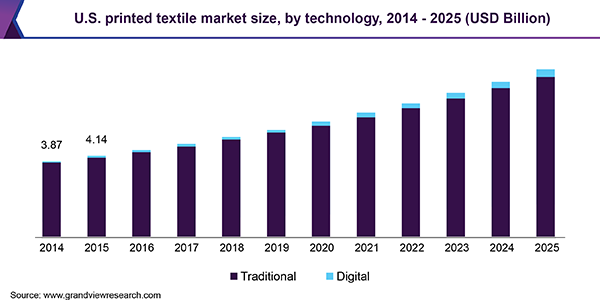
Printed fabrics provide better bonding of the color with the fibers in order to resist friction and washing. Furthermore, the ascension consumer disposable income in the emerging economies, including China, Republic of india, and Brazil is estimated to augment the consumption of printed wear, thereby complementing market growth.
The increasing demand for unique clothing by the millennial population in the U.South. is estimated to have a positive impact on marketplace growth in the state. In addition, access to eastward-commerce portals for shopping of apparels coupled with increasing imports of printed textiles in the country is anticipated to augment the product demand over the forecast menstruation.
The factors such as loftier reliability, uninterrupted printing, toll-effective production, and design versatility contribute positively to the growth of printed textiles globally. Furthermore, emptying of screen cost in sampling coupled with short-run product in digital textile printing is predictable to augment the penetration of the technique in mass customization, thereby complementing market growth.
Rapid growth in the demand for digital applied science in fabric printing for garment and advertising industries coupled with increasing need for sustainable press is anticipated to take a positive impact on the production demand over the forecast period. Furthermore, reduction in per-unit cost of printing along with shortening lifespan and faster adaptability with the advent of digital printers is likely to complement market place growth.
Rapid technological developments in the textile printing industry coupled with the introduction of single-pass, high-speed large printers have resulted in the up-gradation of traditional textile printing machines, thereby complementing the printed material market growth. Still, high press costs and harmful environmental touch associated with traditional textile printing techniques are expected to hamper the manufacture growth.
Ink Type Insights
Pigment dyes are independent of the type of cobweb and are used to impress on natural as well every bit synthetic fabrics. In addition, these inks are majorly used in traditional printing techniques attributable to the process being the most economical. Furthermore, the ability of pigment printing inks to be applied to all substrates, including leather, PVC, and glass fibers is expected to boost the need for pigment dyes over the forecast menstruation.
Reactive dye inks are used majorly for printing on natural fibers such as cotton wool, silk, wool, and viscose attributable to its ability to react with the chemicals in the press paste to bond the colors to the fibers after being steamed. In addition, these inks provide loftier launder fastness, which enables colour retentivity even afterward washing, thereby increasing its penetration in the press of fabrics over the projected period.
Acrid dye inks are estimated to business relationship for vi.92% by 2025 owing to its ability to provide vibrant colors to materials that practise not retain the color after printing including, silk, wool, or lycra fabrics. In addition, acid inks accept a high tolerance to chlorine and water, thereby increasing its penetration in printing for swimwear textiles over the forecast menses.
The disperse dye inks are sprayed directly on the polyester fabrics at loftier temperatures for the incorporation of the dye into the fibers. The application of these inks for printing on fabrics used outdoors such as flags, banners, home textiles, and apparel is estimated to augment the material need in the printed textiles market place.
Product Insights
The backdrop of cotton wool fiber such as loftier durability, biodegradable, practiced absorbent, and high insulating property aids in it beingness an ideal fabric for vesture and other household application. In addition, and like shooting fish in a barrel printing power of the material aids in boosting the product demand in printed textiles over the forecast period.
Polyester printed textiles are expected to account for a significant share owing to the product's properties such as high strength, low textile cost, resistance to shrinking, wrinkles, and chafe. Withal, low absorbency of the product is predictable to restrict its need for textile printing over the forecast catamenia.
The increasing demand for silk printed clothing in the Gulf countries and Japan is probable to contribute positively to the demand for silk in printed textiles. Notwithstanding, the high price associated with the printing and manufacturing of silk fabric has restricted the usage of silk to certain economies, thereby limiting the growth of silk printed textiles.
Hybrid or blend fabrics aid in providing aesthetic comfort properties of natural fibers with the strength of synthetic fibers . The features of cotton blends such as resistance to fierce and abrasion, low cost, high immovability, and breathability aid in contributing positively to its usage in textile printing over the projected period.
Engineering science Insights
Traditional printing technology is estimated to witness growth at a CAGR of viii.vii% from 2019 to 2025, in terms of revenue on account of the presence of numerous techniques such as block, batik, roller, and stencil existence used extensively over the past few years. Furthermore, the presence of skilled labor in economies such as Republic of india, Brazil, and Indonesia for printing on textiles is predictable to boost the growth of traditional printing.
Various traditional printed techniques including rotary screen fabric press, hand screen printing, dye-sublimation transfer printing, and automatic flat screen printing are used for mass press of the textiles. Furthermore, the ability to use any ink as per requirement in this press technique for commercial printing is probable to boost the market place growth.
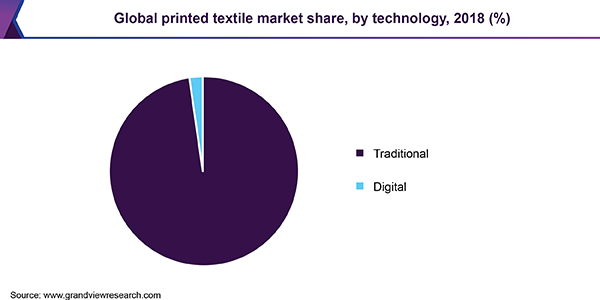
The adoption of digital press is expected to witness significant growth attributable to its attributes such as environment-friendly, low printing cost, and high precision in the desired designs. In improver, the ability to print on any size or dimension fabrics using digital technology is expected to assist market growth.
Digital printing offers high-resolution prints with unlimited colour combinations and utilizes less amount of ink, electricity, and water as compared to other techniques. In addition, the infinite required for the printing machines is comparatively less, thereby enabling high-quality printing in smaller areas. The aforementioned factors are expected to drive the demand for digitally printed textiles over the forecast period.
Application Insights
The fashion manufacture is witnessing changes based on changing consumer preferences. The increasing focus of the fashion designers and clothing companies on creating new designs to increase their marketplace share and client base is expected to drive the demand for printed textiles in the fashion industry significantly.
The increasing penetration of printed textiles in various household applications such equally upholstery, kitchen clothing, soft furnishing, and bedding is likely to contribute positively to the market growth. Furthermore, rise demand for renovation and interior designing amidst the consumers is anticipated to augment the demand for printed textiles.
Technical textiles accounted for 8.6% of the global acquirement share in 2018 on business relationship of the increasing penetration of the production in construction, transportation, medical, and protective applications. In improver, ascent consumer awareness for using aesthetically appealing fabrics in various applications is expected to boost the demand for printed fabrics over the forecast period.
Printed fabrics are extensively used for soft signage application, wherein display boards made of cloth is printed for decoration and advertising purposes. Furthermore, increasing penetration of soft signage and growing demand for advertising is anticipated to boost the demand for the production, at a CAGR of 8.2 % from 2019 to 2025, in terms of revenue.
Regional Insights
The demand for the product in Europe was valued at USD 75.89 billion in 2018 and is dominated by the rapidly growing style industry in France, Italy, the United kingdom, and Federal republic of germany. In addition, an increasing number of upcoming apparel companies and fashion designers in the region is expected to have a positive impact on the demand for printed fabrics in the region.
Rising demand for printed habitation textiles in the United Arab Emirates is expected to contribute significantly to the market growth in the Middle Due east & Africa region. In improver, changing consumer preferences from plain solid clothing to printed habiliment among the people is anticipated to boost the demand for the product in the fashion application in the region.
Asia Pacific is expected to witness growth at a CAGR of 9.v% from 2019 to 2025, in terms of revenue on business relationship of the increasing consumption of printed clothing in Republic of india, China, Japan, Indonesia, and Thailand. In addition, the rise adoption of digital cloth press in Prc and Republic of india is anticipated to boost the market growth in the region.
Increasing sales volume of clothing appurtenances and apparel through e-commerce portals in Mainland china, India, Thailand, and Bangladesh is estimated to heave the industry growth. In addition, favorable government regulations in China and India for promoting investment in fabric manufacturing and printing is anticipated to complement market place growth.
Key Companies & Market Share Insights
The major players in the market include Fabric Wholesale Direct, Seride Srl, Seiko Epson Corporation, Kornit Digital, Roland DGA Corporation, Konica Minolta, Inc., Hollyflower, Shahlon Group, and Globe Textiles (India) Ltd. These companies are engaged in providing extensive, customized printed textiles in a wide range of fabrics and designs.
Companies decide the cost of printed fabrics based on diverse factors including the printing technique used, ink types, base fabrics, customization, design complications, application of the end product, and types of color dyes. Furthermore, the entire printing process is customization based and varies according to the requirement of the customer.
Printed Textile Market Report Scope
| Written report Attribute | Details |
| Market size value in 2019 | USD 145.63 billion |
| Revenue forecast in 2025 | USD 266.38 billion |
| Growth Rate | CAGR of 8.9% from 2019 to 2025 |
| Base year for estimation | 2018 |
| Historical data | 2014 - 2017 |
| Forecast catamenia | 2019 - 2025 |
| Quantitative units | Revenue in USD billion and CAGR from 2019 to 2025 |
| Report coverage | Revenue forecast, visitor ranking, competitive landscape, growth factors, and trends |
| Segments covered | Ink Type, product, technology, awarding, region |
| Regional telescopic | North America; Europe; Asia Pacific; Cardinal & Due south America; Middle East & Africa |
| Country scope | U.S., Canada, Mexico, France, Germany, Italy, Russia, Turkey, United kingdom of great britain and northern ireland, China, India, Japan, Indonesia, Thailand, Argentine republic, Brazil, United Arab Emirates, S Africa |
| Key companies profiled | Fabric Wholesale Straight, Seride Srl, Seiko Epson Corporation, Kornit Digital, Roland DGA Corporation, Konica Minolta, Inc., Hollyflower, Shahlon Group, and Globe Textiles (India) Ltd. |
| Customization telescopic | Gratis report customization (equivalent up to 8 analysts working days) with buy. Addition or alteration to country, regional & segment scope. |
| Pricing and purchase options | Avail customized buy options to come across your exact research needs. Explore buy options |
Segments covered in the study
This report forecasts acquirement growth at global, regional, and country levels and provides an analysis of the industry trends in each of the sub-segments from 2014 to 2025. For this report, Grand View Enquiry has segmented the global printed textile market place based on ink type, product, engineering, application, and region:
-
Ink Blazon Outlook (Volume, Million Square Meters; Revenue, USD One thousand thousand; 2014 - 2025)
-
Acid dye
-
Disperse dye
-
Pigment dye
-
Reactive dye
-
Others
-
-
Product Outlook (Volume, Million Square Meters; Revenue, USD 1000000; 2014 - 2025)
-
Cotton wool
-
Silk
-
Polyester
-
Others
-
-
Technology Outlook (Book, One thousand thousand Foursquare Meters; Acquirement, USD Million; 2014 - 2025)
-
Traditional printing
-
Digital printing
-
-
Awarding Outlook (Volume, Million Square Meters; Revenue, USD Million; 2014 - 2025)
-
Fashion
-
Household
-
Technical textiles
-
Others
-
-
Regional Outlook (Volume, Million Square Meters; Revenue, USD Million; 2014 - 2025)
-
North America
-
The U.S.
-
Canada
-
United mexican states
-
-
Europe
-
French republic
-
Germany
-
Italy
-
Russia
-
Turkey
-
Britain
-
-
Asia Pacific
-
China
-
India
-
Japan
-
Indonesia
-
Thailand
-
-
Central & South America
-
Argentina
-
Brazil
-
-
Middle E & Africa
-
South Africa
-
United Arab Emirates
-
-
Source: https://www.grandviewresearch.com/industry-analysis/printed-textile-market
0 Response to "what information do market analysts provide to textile manufacturers"
Publicar un comentario